 STACEY LAYNE MARTIN
UX & SERVICE DESIGN LEADER
Five Levers of Fidelity for Design Socialization
A joke, a contractor, and Toulouse-Lautrec – Hard lessons on fidelity in the age of AI from a service designer who should’ve known better.
It was supposed to be a joke. At any moment, anything I can imagine becomes a prompt for my ChatGPT mobile app. It can be generated seconds after the thought appears, in high-fidelity, golden-hour lit photo quality. It’s still a funny thought in my head seconds later – the image is sent to my coworker. The image sat for two minutes without a response. When I took a second look, I realized, “Oh no. This looks romantic.” I immediately revisited ChatGPT to iterate quickly: revise, revise, revise. Finally, the right image to match the comedic quality of my intent: stick people. But at that point, continuing to send revisions of an image that should never have been created in the first place would only have added insult to injury.
I know nothing of building construction outside of small home remodels and Ty Pennington’s Extreme Makeover: Home Edition episodes. This was my first commercial project with a gutted warehouse, and I wanted to make sure I captured everything in my head. The future glorious home would be our commercial gym relocation. Thanks to the support of Claude, I detailed the requirements for every nook and cranny – from plumbing, to sound, to lighting, together we would come to calculate every inch of pipe, walls, and wiring. It was a near-perfect rendition of the vision. What resulted was an estimate from the contractor totaling over $600,000. I became nauseous. My thoroughness conveyed a meaning I had not intended. It looked like I knew exactly what I was doing when I absolutely did not. In fairness, the contractor’s estimate was an exact response to my exact request. But the perfection of it all had removed the opportunity for us to work through the problem-solving together and have those important conversations about feasibility and trade-offs.
If you love art, you might have heard of Henri de Toulouse-Lautrec, a post-impressionist artist of the late 1800s. Lautrec had a predilection for the cancan dancers at the Moulin Rouge, which he was known to frequent. It was said that he would draw the dancers on cocktail napkins while he observed them. Today, an original Lautrec will set you back millions, but those napkins… gone. They didn’t last. They weren’t meant to. Those sketches captured the ideas in motion and were of the moment. Napkins aren’t singular to Lautrec. Napkins are still a way, even today, to capture creative sparks in the moment, whether it was during breakfast coffee or evening cocktails. This was quintessentially low-fidelity art in practice.
Thanks to modern technology, we can now bypass the sketch altogether. We can take a barely thought-out concept, write a two-sentence prompt with our friendly, local AI tool. In seconds, we can produce something that once took hours or days. What was meant for stick figures or back-of-the-napkin thinking can now look like a fully interactive website in minutes. Or worse, a romantic photo. In corporate America, both are just as damning.
High fidelity used to be a constraint. It meant time was spent, it was imbued with intention, it was researched, critiqued, and it was approved for release. Craft and finished were never the same thing – but craft was a reliable signal of finished, and everyone’s instincts calibrated on it. AI broke the signal, not the craft. Our new ability to spin up a polished design or complete website, at first blush, feels like a gift. Now that the constraint is gone, the stakes have gone up and the world hasn’t adjusted – so designers are handed a new responsibility. And that responsibility is to use fidelity itself as a signal to the audience throughout the stages of the design process. Sure, a low-fidelity design invites critique, but it also informs reviewers of their own role or responsibility. A failed product isn’t the singular fault of a designer. Failure occurs when review gates don’t get the signals they need.
The Five Levers of Fidelity
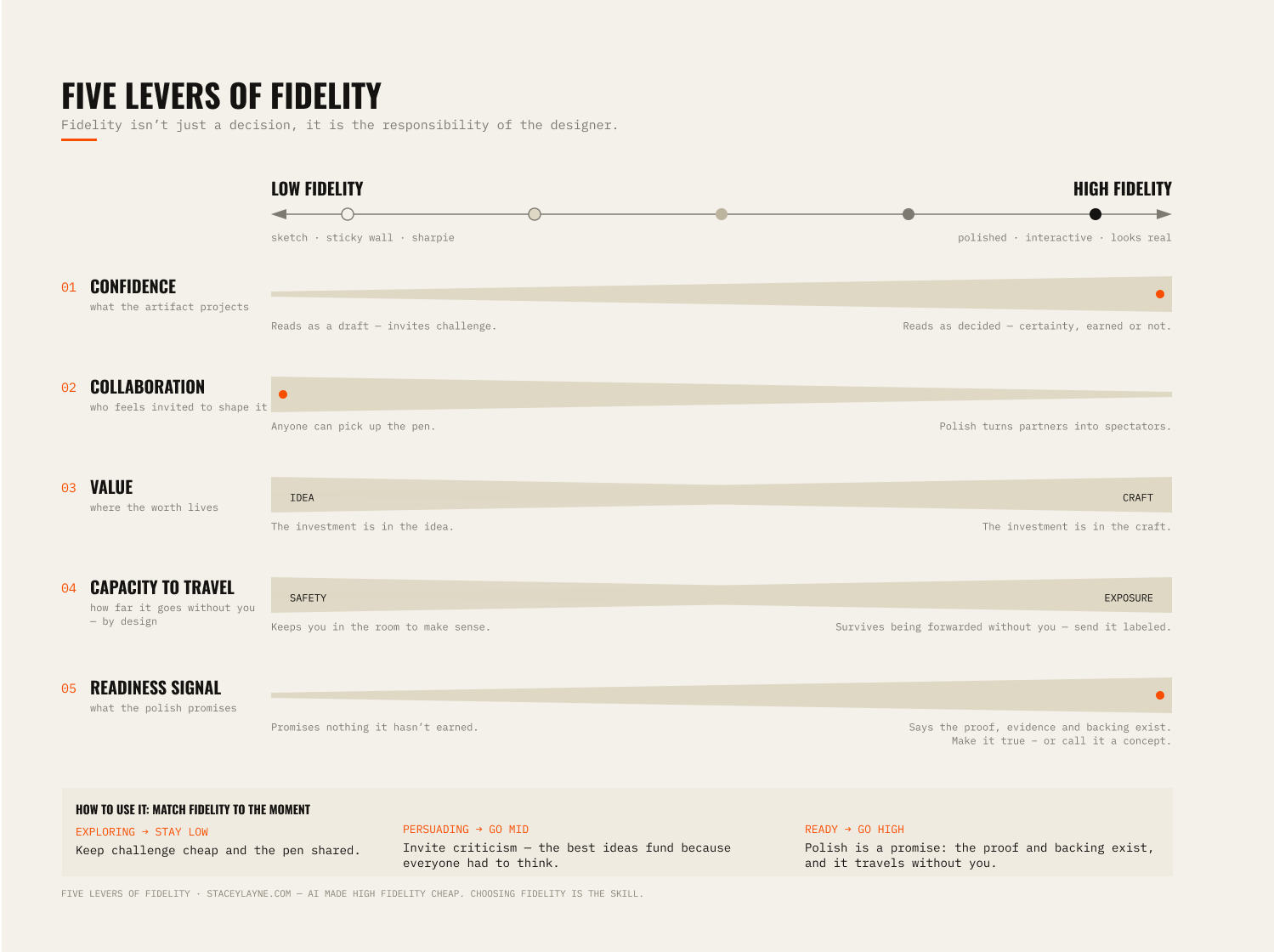
In this moment, when AI has removed the constraints of the build, we start to see the other benefits that low-fidelity visualizations offered. Enter the Five Levers of Fidelity, a guide for matching fidelity to intention and design stage, and for building the review gates mindfully. Fidelity carries two responsibilities: the maker’s, and the reviewer’s (teammate, partner, or approver).
Confidence
JUICEROIn 2016, Juicero launched a machined, counter-worthy home juicer, billed by the company as the first home cold-press machine. It launched at a healthy $699 with proprietary QR-coded produce packets. A category-defining final product launched to consumers had surely been through the rigor required to produce this level of manufacturing, distribution planning, and feasibility assessment. To get this far into production, it had obviously been challenged every step of the way and stood up to scrutiny, right? Investors thought so when they put in roughly $120M before anyone actually squeezed the packet. But in April of 2017, a Bloomberg reporter squeezed that packet by hand faster than the machine. The whole company was shut down by September.
A crude rig of packet-plus-press in a conference room would have asked the necessary question: Do you need the press at all? That’s the question that costs very little at draft fidelity.
The level of finish projects how certain you are. A draft invites a challenge, and polish reads as decided. Historically, deep research and testing brought certainty, and that work earned credibility – perhaps even a seat at the table. Today, we can create the appearance of that certainty without the deep work. And the mental models haven’t caught up: polish still reads as trustworthy work. It sounds tempting to be able to produce that quickly. But you have to ask yourself as a designer, is that a check that you want to cash when you don’t have the receipts? (Bias link: halo effect + processing fluency.)
Collaboration
AIRBNBAirbnb pulled the collaboration lever in the right direction. In 2012, Airbnb hired a Pixar-trained artist to storyboard the entire guest journey, frame by frame. This would come to be known as the Snow White project. CEO Brian Chesky said, "When you have to storyboard something, the more realistic it is, the more decisions you have to make." As layers of fidelity were added to the sketch, more details had to be hashed out. Everyone in the room contributed to those details, wrestled with them. According to Fast Company, the Snow White project would go on to steer the company’s mobile strategy. The decisions that surfaced were co-authored in the room and made while it was still easy to apply the eraser.
My contractor spec pulled this lever the wrong way. The finish said the decisions were already made, and it closed the trade-off conversation I so badly needed.
The fidelity level signals who can pick up the pen and the kind of contributions one can make. A draft recruits co-creation, but polish turns reviewers into spectators. The type of feedback one offers at these polarities changes. (Bias link: anchoring + design fixation – the first concrete artifact becomes "the design.")
Value
BRANDLESS + CHICK-FIL-AIn 2017, a direct-to-consumer grocery startup created an edgy identity that was devoid of branding. It consisted of plain white labels and flat $3 pricing. Like I said, edgy. They touted that because they did not waste money on expensive branding, they could pass savings on to the customer. They wanted to signal that the value was the product, not the package. But with the basic packaging, they actually signaled that the product was also basic. The company was shut down, and part of what failed was the disconnect in the signal itself. The company had a good point: packaging and branding aren’t the value. But they missed the fact that customers rely on packaging to communicate the value. When you put effort and care into your packaging, I can trust that you put the same into your product. It’s the same reason Chick-fil-A perfects the greeting at every counter in the country: the care a customer can see becomes their evidence for the care they can’t – the kitchen, the sourcing, the food. Designers have a word for this kind of visible care: craft. Craft is the investment a reviewer can inspect – and it stands as evidence for every investment they can’t.
In design terms: At first impression, the finish demonstrates its investment. Simple says "the investment is the idea, so far." Polish says "the investment is in the craft." Both are honest signals, but a mismatch between the investment shown and the worth intended is what's fatal. (Bias link: aesthetic-usability effect – beautiful reads as better.)
Capacity to Travel
THE WOODEN PALMPILOT + AMAZON'S SIX-PAGERIn the mid-1990s, Jeff Hawkins of Palm would carry a block of wood cut to pocket size and “use” it in meetings to test whether a palm-sized device fits into a day-in-the-life. The only decisions this was intended to inform were size and feel. It could not be mistaken for the product; it couldn’t claim more. The block of wood would not find itself in a boardroom for approvals.
More recently, Jeff Bezos of Amazon instituted six-page narrative memos for silent reading before meetings started. This memo did what PowerPoint slides couldn’t: carry the weight of prose. The memo carried its meaning whether or not the author was in the room.
This is the capacity to travel lever, done the right way. Both of these artifacts tell the truth about what they are. Their range and readiness are built in. One limits how far it can travel; the other equips it.
A new phenomenon my team and I are experiencing is that AI-designed digital prototypes are traveling into executive meetings we were not invited to; designs are presented disembodied from their designer at stages that appear high quality, but on closer look are not anchored in the kind of research and decisions they seem to claim.
Finish governs how far an artifact can go without you. When fidelity had cost something, the level of finish told the truth about an artifact's range – who should see it, what's still unverified. That truth-telling is a safety feature, and AI removed it. We can’t always control the unsupervised life of an artifact. What we can control is whether it travels labeled – its state qualified and carried with it into rooms we’ll never see. The wood block labeled itself; it was wood. Now the label is ours to write. (Bias link: diffusion of responsibility – every room assumes the last room checked it; polish accelerates the assumption.)
Readiness Signal
NIKOLA ONEIn 2016, a promo video showing a Nikola One electric semi cruising down a highway was released to the public and investors. A truck that could not yet drive itself was demonstrated to be driving itself. How did they do it? The company towed the truck to the top of a shallow hill and let the truck roll down. They tilted the camera so the grade read as a flat road. The video was titled “In Motion,” a signal that they had achieved engineering readiness, when, in fact, they had not. At best, the promotion got ahead of the product; at worst, investors were misled about what existed. The impact of that belief was that investors had priced the company based on an achievement that never happened. In 2020, the company finally admitted the truck was rolling downhill with no working powertrain.
The vehicle industry already knows how to pull this lever honestly. It invented an artifact for it: the concept car. Maximum craft, and its state stamped into its name – nobody at the auto show believes it’s in production, and nobody is misled when it never ships. The room knows its job: imagine, react, want. Same theatrical polish as that promo video. The only difference is the label.
Fidelity is a claim about what exists. The finish of the representation gets read as the readiness of the thing it represents – a video for a truck, a prototype for a product. This is the responsibility lever. Designers are meant to show the art of the possible. But doing so without caveating the feasibility gaps is misleading. (Bias link: the effort heuristic – effort spent on the representation gets credited to the thing it represents, and AI and video production can counterfeit the receipts.)
In a meeting with younger designers recently, someone confessed they couldn’t remember the last time they wrote something down with pen and paper. I’ll forever hang onto my notebooks because they feel native to me – I could draw a whole scene while awaiting the AOL dial-up internet, but the reality is that today we cannot expect a generation raised on Intel chips to appreciate a college-ruled spiral notebook the same way. With AI, we have to consider what fidelity means outside of its practical limitations. So maybe it is no longer a napkin, a pencil, or a sketched wireframe.
Prompting for Fidelity, AI Disclosures, and Citations
NNg offers advice for prompting to fidelity: include the intent and the spec. That same pair is your citation. Putting your full prompt in a citation seems obnoxious, while the intent and spec are far more useful for the reviewer to know. Intents such as “concept exploration” or “proof of concept” start to name a stage for someone who understands the design phases — and set into the context of all the design stages, they tell the reviewer what their feedback will inform next.
Advertising already gave us the precedent. Before final art was licensed, creative teams stamped FPO — “for placement only” — across the image. The stamp didn’t apologize for the placeholder; it marked it honestly, so nobody approved the comp thinking the photography was final. An honest fidelity or AI disclosure is the same move.
Cite your AI use with the intent and the spec. It’s the FPO stamp for our era — and it tells the reviewer their job.
The artifact declares its stage.A Note on Testing
Even skilled researchers have blind spots. Coca-Cola proved it in 1985 with the rollout of New Coke. Researchers performed blind taste tests between New Coke and the original Coca-Cola. Stripping away everything but the taste created an isolated focus. This is low fidelity by design. New Coke beat the original, hands down. The company moved to release New Coke and pull the old formula off the shelves. A massive public uproar erupted, and organized campaigns formed to bring back the original formula. The sip tests were meant to isolate the flavor. The question that needed testing, however, was the removal of the product. The can, the logo, the ritual, and the loyalty all meant something to people. While this was the right way to test, it answered the wrong question.
Testing requires the same intention the levers ask of the room. High fidelity does increase confidence and that can make sense when trust is being tested. But similarly, users respond to fidelity, providing feedback on different factors depending on the polish. Producing a wrong-fidelity test situation risks contaminating the signals meant to be measured.
As designers in our expanding AI-enabled world, we’d do well to remember that we are conveyors of ideas through processes and people and channels. Our responsibility is to accurately represent the design stage to whoever receives the work. And if you happen to find yourself simply sending a funny meme you created in .03 seconds with AI, I’d recommend taking a beat before you hit send on that text.
AI disclosure (with the inevitable em dash) — intent and spec, as this article recommends. Intent: research, editing, and graphic production in service of an argument that is my own. Spec: Claude (Anthropic) found and verified the sources, fact-checked the examples, pressure-tested the drafts, and built the graphics to my art direction and visual system. The five levers, the stories, and the taste are mine. The receipts are real.
References + Further Reading
ON THE EXAMPLES
Brandless: Attest. What went wrong with Brandless? askattest.com
Juicero: The Guardian (Sept. 1, 2017), on Juicero’s shutdown. theguardian.com
Airbnb’s Snow White storyboards: Fast Company (2012). How Snow White helped Airbnb’s mobile mission. fastcompany.com
The wooden PalmPilot: Computer History Museum. Jeff Hawkins’ block-of-wood prototype. computerhistory.org
Amazon’s six-page memos: CNBC (2018). Why Jeff Bezos makes Amazon execs read 6-page memos at the start of each meeting. cnbc.com
Nikola One: Slashdot, via the Financial Times (2020). Nikola admits prototype was rolling downhill in promo video. slashdot.org
ON TESTING
Rudd, J., Stern, K., & Isensee, S. (1996). Low vs. high-fidelity prototyping debate. Interactions, 3(1). dl.acm.org
ON INFLUENCE
Cialdini, R. B. (1984). Influence: The Psychology of Persuasion; republished as Influence: Science and Practice (1985).
PRIOR ART ON FIDELITY
Houde, S., & Hill, C. (1997). What do prototypes prototype? In Handbook of Human-Computer Interaction (2nd ed.).
Topper, A. A framework for prototype fidelity. Walmart Global Tech. medium.com
Interactions magazine (July–August 2026). Rethinking prototype fidelity in the age of generative AI: When high-fidelity becomes cheap, it’s time to revisit our foundational design wisdom. interactions.acm.org
Adolphs, C. The fidelity trap. AICE Labs. aicelabs.com
Nielsen Norman Group. AI prototyping in real design contexts. nngroup.com
ON BIAS
Kruger, J., Wirtz, D., Van Boven, L., & Altermatt, T. W. (2004). The effort heuristic. Journal of Experimental Social Psychology, 40(1). — quality judged by apparent effort; the research behind “receipts for effort you never paid for”
Thorndike, E. L. (1920). A constant error in psychological ratings. Journal of Applied Psychology, 4(1). — the halo effect
Reber, R., & Schwarz, N. (1999). Effects of perceptual fluency on judgments of truth. Consciousness and Cognition, 8(3). — processing fluency: easier to take in reads as more true
Tversky, A., & Kahneman, D. (1974). Judgment under uncertainty: Heuristics and biases. Science, 185. — anchoring
Jansson, D. G., & Smith, S. M. (1991). Design fixation. Design Studies, 12(1). — examples narrow what designers imagine next
Kurosu, M., & Kashimura, K. (1995). Apparent usability vs. inherent usability. CHI ’95 Conference Companion. — the aesthetic-usability effect
Tractinsky, N., Katz, A. S., & Ikar, D. (2000). What is beautiful is usable. Interacting with Computers, 13(2).
Darley, J. M., & Latané, B. (1968). Bystander intervention in emergencies: Diffusion of responsibility. Journal of Personality and Social Psychology, 8(4).
Kruger, J., & Dunning, D. (1999). Unskilled and unaware of it: How difficulties in recognizing one’s own incompetence lead to inflated self-assessments. Journal of Personality and Social Psychology, 77(6).